
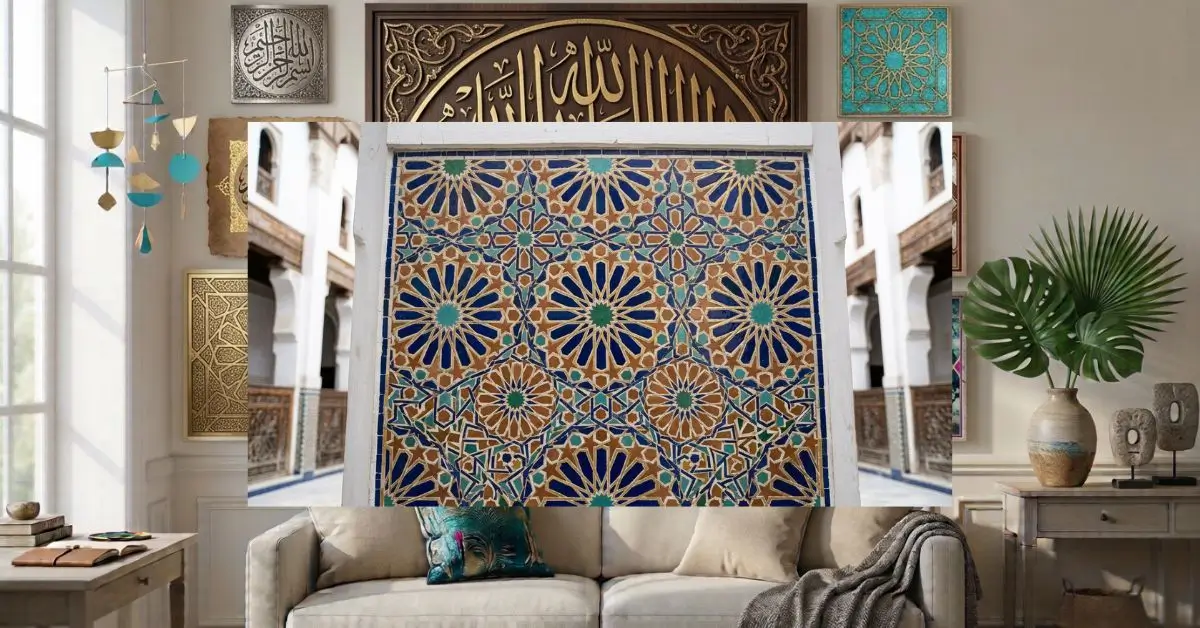
Islamic geometric patterns are decorative designs created through the repetition, arrangement and combination of geometric shapes. They are recognised for their symmetry, intricate details and balanced compositions, making them an important feature of Islamic artistic traditions.
These patterns can be found in architectural decoration, mosque interiors, ceramic tiles, wooden panels, textiles, manuscripts and contemporary artwork. They often use basic shapes such as circles, squares, triangles and polygons to create more complex designs, including stars, interlocking shapes and repeating grids.
One of the most interesting features of Islamic geometric art is how simple shapes can form detailed compositions. A single design unit can be repeated, rotated or reflected to create a larger pattern that appears continuous and interconnected.
Today, these designs continue to inspire decorative artwork, modern interiors and creative projects. Understanding their structure, common types and design principles can help you appreciate their beauty and explore ways to incorporate them into your surroundings.
What Are Geometric Patterns in Islam?
Islamic geometric patterns are decorative arrangements built from geometric shapes and mathematical relationships. They commonly feature repetition, symmetry, proportion and interconnected forms.
Artists and craftspeople have used these designs across different regions and periods of Islamic art. Their patterns appear on surfaces ranging from architectural walls and ceilings to ceramics, textiles, metalwork and decorative objects.
The designs often begin with simple geometric elements. Circles and straight lines can be used to construct polygons, stars, and repeating arrangements. These individual shapes are then combined to create compositions with visual balance and continuity.
According to the Metropolitan Museum of Art’s explanation of geometric patterns in Islamic art, geometric ornamentation developed through the combination and repetition of basic forms, including circles and squares. The patterns became an important decorative feature across different types of objects and architecture.
Islamic geometric designs are not limited to one fixed pattern or regional style. Their appearance varies according to the artistic traditions, materials and techniques used by different communities.
What Are Arabic Patterns Called?
The phrase “Arabic patterns” is often used broadly to describe decorative designs associated with Arabic and wider Islamic artistic traditions. However, different types of ornament have their own names.
Some commonly used terms include:
- Islamic geometric patterns: Designs made from repeating geometric shapes, stars, polygons and symmetrical arrangements.
- Girih patterns: Interlacing geometric designs associated particularly with Persian and neighbouring architectural and decorative traditions.
- Tessellations: Repeating arrangements of shapes that fit together without gaps or overlaps.
- Arabesque patterns: Flowing decorative designs based mainly on scrolling stems, leaves and plant-like forms.
- Calligraphic patterns: Decorative compositions created using artistic lettering, often Arabic calligraphy.
These terms describe different artistic approaches. For example, an arabesque is generally based on flowing vegetal forms, while geometric ornament is constructed from shapes, lines and repeated arrangements.
In many Islamic artworks, geometric, vegetal and calligraphic elements are combined to create detailed decorative compositions.
What Are the Main Types of Islamic Geometric Patterns?
Islamic geometric art includes many variations, but several design types appear frequently in traditional and contemporary artwork.
1. Star Patterns
Star patterns are among the most recognisable features of Islamic geometric decoration. They are created by arranging and connecting polygons or intersecting shapes to produce star-like forms.
Common examples include:
- Eight-pointed stars.
- Six-pointed stars.
- Ten-pointed stars.
- Twelve-pointed stars.
Star designs can appear as individual motifs or as part of larger repeating compositions. They are often combined with smaller polygons and interlocking shapes to create detailed decorative surfaces.
2. Polygonal Patterns
Polygonal designs use shapes with straight sides, such as triangles, squares, pentagons, hexagons and octagons.
These shapes can be arranged in different combinations to create balanced and repeating patterns. For example, hexagons can be connected with smaller triangles, while squares can form the foundation for more complex geometric arrangements.
Polygonal patterns are particularly useful for creating structured artwork with clear lines and repeated shapes.
3. Interlocking Patterns
Interlocking patterns are created when geometric shapes connect or overlap visually to form a continuous design.
These compositions often include stars, polygons, connecting lines and repeated decorative units. Their structure can make the pattern appear as though each shape is connected to the next.
Interlocking designs are commonly used in decorative tiles, architectural surfaces and ornamental panels.
4. Circular and Rosette Patterns
Circular patterns use circles, radial lines and repeated shapes arranged around a central point.
A rosette is a decorative motif that often resembles a flower or star, with elements extending outward from the centre. These designs can be simple or highly detailed, depending on the number of shapes and layers involved.
Circular arrangements are useful when creating symmetrical artwork with a clear central focus.
5. Tessellated Patterns
Tessellation describes an arrangement in which shapes fit together across a surface without gaps or overlaps.
Squares, triangles and hexagons are examples of regular polygons that can form repeating tessellations on their own. More complex Islamic designs can combine different shapes to create intricate repeating surfaces.
Tessellated patterns are especially common in tilework, flooring, wall decoration and architectural ornament.
Why Are Symmetry and Repetition Important in Islamic Geometric Art?
Symmetry and repetition are two important principles behind the appearance of Islamic geometric patterns.
Symmetry creates visual balance by arranging shapes in a way that reflects or repeats around a line or central point. It helps the design appear organised, even when it contains many intricate details.
Repetition allows a basic shape or design unit to be used multiple times. By repeating, rotating or reflecting the same element, an artist can create a much larger composition.
Another important feature is the sense of continuity. Some patterns appear as though they could extend beyond their visible boundaries, giving the design a feeling of movement and connection.
These principles help explain why Islamic geometric art can look complex while remaining visually structured.
How to Make Islamic Geometric Patterns Step by Step
You can create a simple geometric design using basic drawing tools. A compass, ruler, pencil and paper are enough to begin exploring the construction of symmetrical patterns.
Follow these steps to create a simple eight-pointed star design.
Step 1: Draw a Circle
Use a compass to draw a circle. This will provide the boundary and starting point for your design.
Step 2: Mark the Centre
Identify the centre of the circle. Draw a horizontal and vertical line through it to divide the circle into four equal sections.
Step 3: Divide the Circle Further
Add diagonal lines to divide the circle into eight equal sections. These lines will help you position the points of the star.
Step 4: Connect the Points
Mark the points where the lines meet the circle. Connect alternate points to create two overlapping squares. This forms an eight-pointed star.
Step 5: Add Repeating Details
Draw smaller shapes, parallel lines or additional geometric elements around the central star. Keep the spacing consistent to maintain symmetry.
Step 6: Develop the Pattern
Repeat the star design or connect it with other geometric units to create a larger composition.
Step 7: Add Colour
Choose a coordinated colour palette. Traditional-looking combinations may include blue, turquoise, white, green and gold, while contemporary designs can use neutral shades or contrasting colours.
This is a simple starting exercise rather than a complete reconstruction of a historical pattern. More intricate designs require additional geometric divisions and careful construction.
For further learning, the Metropolitan Museum of Art’s geometric design activities provide educational examples of pattern construction using grids and geometric principles.
Where Are Islamic Geometric Patterns Used?
Islamic geometric designs have been used across a wide range of artistic and architectural applications.
Architecture and Mosque Decoration
Geometric patterns can be found on mosque walls, ceilings, domes, entrances and decorative screens. They are often created using tilework, carved surfaces, woodwork and other architectural materials.
Ceramic Tiles and Wall Panels
Repeating stars, polygons and interlocking shapes are frequently used in decorative tile compositions. Different colours and arrangements can create detailed surfaces across walls and architectural features.
Textiles and Carpets
Geometric designs also appear in woven textiles, carpets and decorative fabrics. Repeated shapes can create structured compositions across large surfaces.
Contemporary Wall Art
Modern artists and designers continue to use Islamic geometric patterns in framed prints, canvas artwork and decorative panels. These designs can introduce visual structure and detail into both traditional and contemporary interiors.
Islamic Geometric Patterns in Modern Interior Design
Islamic geometric artwork can complement modern interiors when its colours, scale and composition are selected carefully.
For minimalist spaces, consider simple geometric patterns with neutral backgrounds and limited colours. For more decorative interiors, detailed star arrangements and interlocking designs can create a stronger visual focal point.
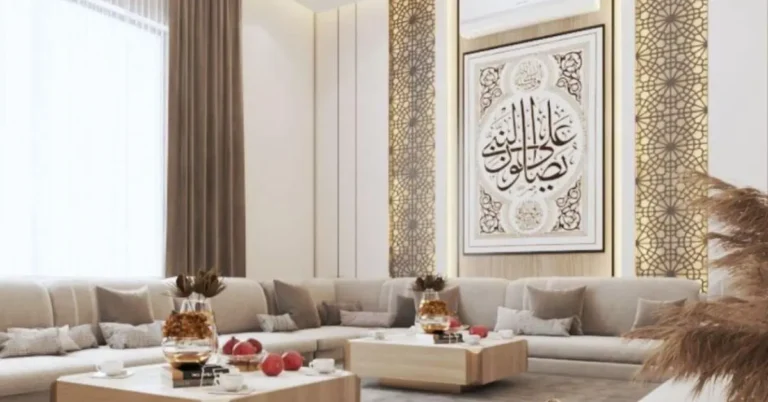
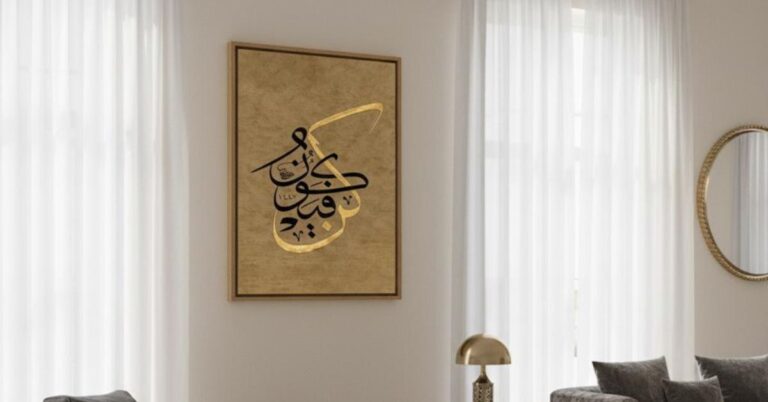
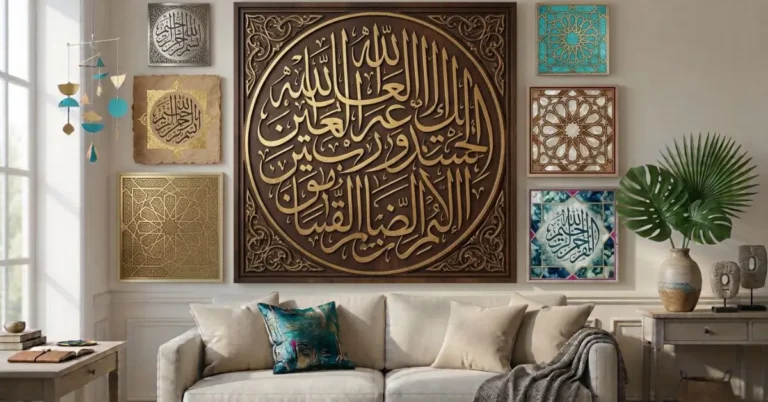
You can also combine geometric artwork with Arabic calligraphy to create a more varied display.
If you are exploring Islamic wall art ideas, consider using geometric designs in living rooms, hallways, majlis areas and offices.
You can learn more about Arabic calligraphy wall art and how lettering-based compositions can complement geometric decoration. For further inspiration, explore Islamic art in modern interior design.
The key is to select artwork that complements the surrounding furniture, wall colours and available space.
Explore Islamic Geometric Artwork at ArtPlus
Islamic geometric patterns offer a wide range of possibilities for decorative artwork. From simple symmetrical arrangements to intricate star compositions, these designs can suit different interior styles and display requirements.
Explore the ArtPlus Islamic Art Collection to discover artwork inspired by Islamic artistic traditions and decorative designs.
Depending on your chosen artwork and desired presentation, you can also explore canvas printing services in Dubai, acrylic printing services and fine art printing services at ArtPlus.
The right printing material depends on the design, level of detail, display location and finish you prefer.
Conclusion
Islamic geometric patterns demonstrate how basic shapes can be transformed into intricate and visually balanced artwork. Through symmetry, repetition, proportion and the arrangement of geometric forms, artists have developed decorative designs that continue to influence architecture, crafts and contemporary interiors.
From star patterns and polygons to interlocking designs and tessellations, each style offers a different way to explore geometric creativity.
Discover the ArtPlus Islamic Art Collection for artwork inspired by Islamic decorative traditions and explore suitable printing options for your interior.
Frequently Asked Questions
What are geometric patterns in Islam?
Islamic geometric patterns are decorative designs made from repeating geometric shapes, including circles, squares, triangles, stars and polygons. They commonly use symmetry, proportion and repetition to create balanced compositions.
What are Arabic patterns called?
The term depends on the design. Geometric ornament may be described as Islamic geometric patterns, while interlacing designs can be called girih patterns. Flowing plant-inspired decoration is generally known as arabesque.
What are the types of geometric patterns?
Common types include star patterns, polygonal designs, interlocking patterns, circular rosettes and tessellations. Each uses different combinations of shapes and repeated arrangements.
How do you make simple Islamic geometric patterns?
Start with a circle, compass and ruler. Divide the circle into equal sections, connect selected points to create a geometric shape, and add repeated details while maintaining symmetry.
What shapes are commonly used in Islamic geometric art?
Circles, squares, triangles, hexagons, pentagons and octagons are common geometric elements. These shapes can be combined to create stars, polygons and complex repeating patterns.

Pingback: 9 Beautiful Islamic Wall Art Ideas for Modern Homes
Pingback: Islamic Art in Modern Interior Design: Traditional & Modern Ideas
Pingback: 9 Islamic Wall Art Display Ideas for Living Rooms and Offices