Table of Contents
- Why Outdoor Tile Performance Matters in the UAE Climate
- Outdoor Printed Ceramic Tiles UAE — Understanding the Basics
- Porcelain vs Ceramic Outdoor Tiles: Which Is Better?
- How Weather-Resistant Ceramic Tiles Handle UAE Conditions
- Why Printed Porcelain Tiles for Outdoors Last Longer
- Outdoor Tile Lifespan—What Affects Durability?
- UV-Resistant Outdoor Tiles for Terraces, Balconies, and Pools
- Heat-Resistant Porcelain Tiles for Exterior Spaces
- Durable Outdoor Tile Surfaces for Commercial Projects
- Best Outdoor Areas for Printed Ceramic Tiles
- Step‑by‑Step Guide: How to Choose Outdoor Printed Ceramic Tiles in the UAE
- Conclusion
- FAQ
Yes, printed ceramic tiles can perform excellently outdoors in the UAE – but only if you choose the right type. UV‑resistant, high‑density porcelain tiles with digitally printed, fade‑proof inks withstand intense sun, sandstorms, humidity, and temperature swings. Standard ceramic tiles without proper coating will crack or fade within months.
I’ve seen beautiful outdoor patios ruined by cheap tiles that turned chalky after one summer. I’ve also installed printed porcelain tiles on a Dubai rooftop terrace that still look brand new after three years. This guide covers exactly what works, what doesn’t, and how to choose outdoor printed ceramic tiles that last.
Why Outdoor Tile Performance Matters in the UAE Climate
The UAE’s outdoor environment is punishing. Temperatures soar above 50°C. UV radiation is extreme. Sandstorms abrade surfaces. Humidity near the coast accelerates material breakdown.
For outdoor-printed ceramic tiles, performance isn’t a luxury—it’s a necessity. The wrong tile can:
- Fade within months
- Crack from thermal shock
- Become slippery when wet
- Show efflorescence (white salt deposits)
Whether indoors or out, the process to print photos on tiles starts with a high‑resolution image and the right material choice.
Understanding material science helps you avoid expensive mistakes.
Outdoor Printed Ceramic Tiles UAE — Understanding the Basics
When we talk about outdoor printed ceramic tiles, we’re primarily referring to porcelain tiles that have been digitally printed with UV-curable or ceramic inks. The image – whether a wood‑look, stone pattern, or custom design – is bonded to the tile surface and sealed.
Key characteristics for outdoor use:
- Water absorption: below 0.5% for porcelain (exterior grade)
- UV stability: inks rated for 500+ hours of accelerated weathering
- Slip resistance: R11 or higher for wet areas
- Freeze‑thaw resistance: surprisingly important for the UAE’s rare but sharp temperature drops at night
Porcelain vs Ceramic Outdoor Tiles: Which Is Better?
This is the most common question. Let me settle it.
Density and Water Resistance
Porcelain is denser and less porous (water absorption <0.5%) than standard ceramic (3–7%). For outdoors, porcelain wins. Water that seeps into ceramic can freeze (yes, desert nights can drop near freezing in winter) and crack the tile.
Heat Resistance Performance
Both materials handle heat, but porcelain’s denser body resists thermal shock better. A sudden rain shower on a blazing hot tile—porcelain is less likely to crack.
Outdoor Lifespan Comparison
| Feature | Porcelain | Standard Ceramic |
| Water absorption | <0.5% | 3–7% |
| UV resistance (printed) | Excellent (with proper ink) | Good to moderate |
| Scratch resistance | Very high | Moderate |
| Suitable for pools | Yes | No (absorb water) |
| Freeze‑thaw stable | Yes | No |
| Recommended for UAE outdoors | Yes | No |
For professional porcelain tile printing in Dubai with UV‑stable inks, choose a studio that tests for outdoor durability.
“I specify only porcelain for any outdoor project in the UAE. Ceramic belongs inside—or in a museum.”
Create a Stunning Outdoor Space That Lasts
UV‑resistant, heat‑proof, and slip‑rated printed porcelain tiles – perfect for Dubai terraces, pool decks, and garden pathways. Free design proof and climate‑tested materials.
Get a Quote for Outdoor TilesHow Weather-Resistant Ceramic Tiles Handle UAE Conditions
Weather-resistant ceramic tiles (i.e., porcelain) are engineered for extremes.
UV Exposure
UV radiation fades organic dyes quickly. Outdoor printed tiles must use UV‑resistant ceramic inks or UV‑cured inks that pass ISO 105‑B02 (colourfastness to light). Ask your supplier for test reports. Without this, your beautiful design will look washed out in one summer.
Sandstorms
Abrasive sand particles can etch soft glazes. Porcelain’s hardness (7+ Mohs) resists scratching. Avoid glossy finishes outdoors – matte or textured surfaces hide micro‑abrasions better.
Humidity and Rain
Porcelain’s near‑zero water absorption means no swelling, no cracking, no mould. Perfect for pool surrounds and outdoor kitchens.
Temperature Fluctuations
From 50°C day to 15°C night, porcelain handles the swing without stress. Always leave expansion gaps during installation.
Why Printed Porcelain Tiles for Outdoors Last Longer
Printed porcelain tiles for outdoors start with a high‑density bisque. The digital print is applied using either of the following:
- UV direct printing: ink cured instantly by ultraviolet light, forming a hard, bonded layer.
- Inkjet with ceramic inks: inks that are fired into the tile surface at high temperatures.
Both methods create fade‑resistant, scratch‑resistant surfaces. The key is ensuring the manufacturer has tested for outdoor UV stability.
Outdoor Tile Lifespan—What Affects Durability?
Here are the four factors that determine how long your outdoor printed tiles will last.
Installation Quality
Poor installation kills more tiles than the weather. Uneven substrate, no expansion joints, or the wrong adhesive cause cracking. Hire a professional familiar with outdoor porcelain.
Printing Technology
UV‑cured or fired ceramic inks are essential. Cheap sublimation prints on uncoated tiles will fade. Ask for a 5‑year UV stability warranty.
Tile Thickness
Outdoor tiles should be at least 9 mm thick for pedestrian use, 20mm for driveways. Thinner tiles crack under point loads (e.g., furniture legs).
Surface Finish
- Matte: hides scratches, good slip resistance.
- Textured: best for pool decks (R12 slip rating).
- Glossy: avoid outdoors (becomes slippery and shows every scratch).
UV-Resistant Outdoor Tiles for Terraces, Balconies, and Pools
UV-resistant outdoor tiles are a must for any sun‑exposed area. Look for:
- ISO 105‑B02 rating of 5 or higher (blue wool scale 7–8 ideal)
- Manufacturer’s guarantee of 10+ years fade resistance
- Dark colours fade faster than light colors—be aware
For a balcony or terrace in Dubai, light-colored porcelain is the best choice to reduce heat absorption (your bare feet will thank you).
Heat-Resistant Porcelain Tiles for Exterior Spaces
Heat-resistant porcelain tiles don’t just resist cracking—they also stay cooler than stone or concrete. Lighter colours reflect sunlight. Some porcelain tiles are formulated with reflective pigments to reduce surface temperature by up to 10°C compared to standard dark tiles.
For outdoor kitchens, use textured porcelain that hides grease and is easy to clean.
Durable Outdoor Tile Surfaces for Commercial Projects
Hotels, restaurants, and shopping centers need durable outdoor tile surfaces that handle heavy foot traffic, trolleys, and constant cleaning. Porcelain with a PEI rating of 4 or 5 (wear resistance) is recommended. UV‑printed custom logos or patterns can be embedded into entrance areas, pool surrounds, or terraces.
A beachfront resort in Ras Al Khaimah wanted a custom logo tile at their pool entrance. We printed on 20mm thick porcelain using UV‑resistant inks. After two years of sun, sand, chlorine, and daily scrubbing, the logo is still sharp, colours still vibrant. The client ordered more for their second phase.
For interior applications with similar durability needs, see how digital printed ceramic tiles for interiors improve high‑traffic commercial spaces.
Best Outdoor Areas for Printed Ceramic Tiles
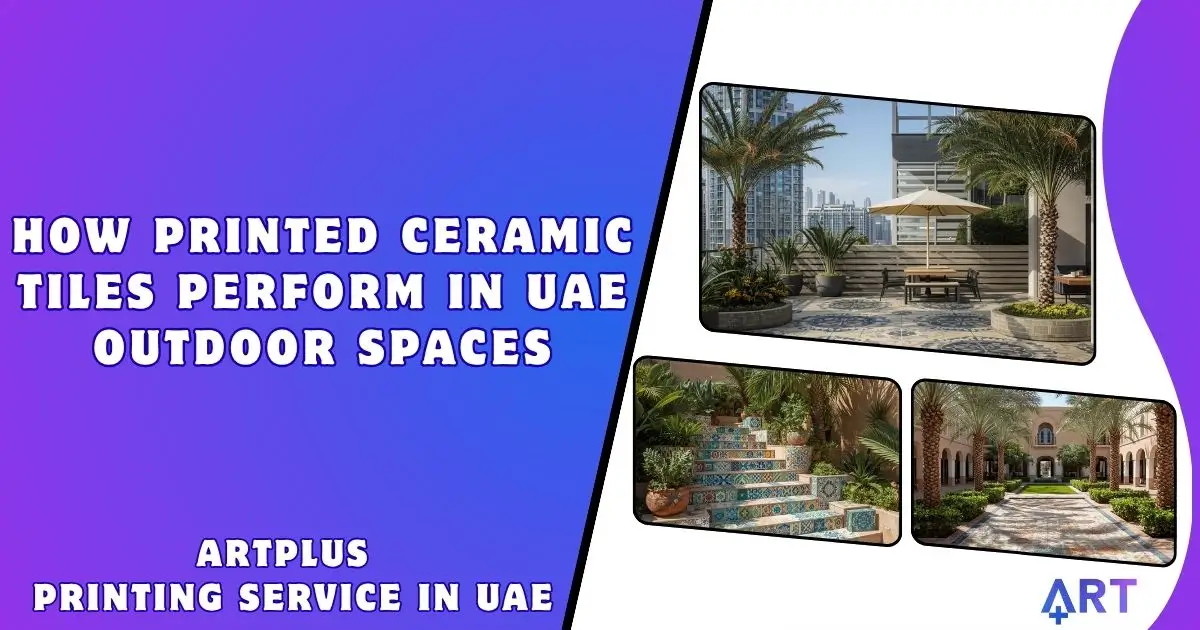
Printed porcelain tiles work beautifully in these specific outdoor zones:
| Area | Recommended Tile | Why |
| Pool deck | Textured, matte, light colour, R12 slip rating | Non‑slip, cool underfoot, resists chlorine |
| Outdoor kitchen | Dark or medium-textured porcelain | Hides stains, heat‑resistant, easy to clean |
| Rooftop terrace | UV‑resistant, light colour, 9mm thickness | Reflects heat, fade‑proof, lightweight |
| Garden pathway | Wood‑look or stone‑look porcelain | Natural aesthetic, durable, no weeding between pavers |
| Hotel outdoor space | Custom printed logo tiles | Branding, durability, professional appearance |
Step‑by‑Step Guide: How to Choose Outdoor Printed Ceramic Tiles in the UAE
Follow this process to avoid costly mistakes:
- Determine the area: Pool, kitchen, terrace, or pathway? Each requires different slip and thickness ratings.
- Check water absorption: Must be <0.5% for exterior use. Ask for the test certificate.
- Confirm UV stability: Request ISO 105‑B02 rating (7–8 is excellent).
- Choose finish: Matte or textured; never glossy.
- Order a sample: Place it outside for one month. Check for fading, staining, or chipping.
- Hire a professional installer: Outdoor porcelain needs special adhesives and expansion gaps.
Conclusion
Printed ceramic tiles can absolutely perform in UAE outdoor spaces – but you must choose porcelain, not standard ceramic. Look for water absorption below 0.5%, UV‑stable inks (ISO 105‑B02 rating 7+), and a matte or textured finish. Install correctly with expansion joints. Used right, your outdoor printed tiles will stay beautiful for two decades, surviving sun, sand, and storms. Explore professional ceramic tile printing services for indoor and outdoor projects with guaranteed fade resistance.
Create a Stunning Outdoor Space That Lasts
UV‑resistant, heat‑proof, and slip‑rated printed porcelain tiles – perfect for Dubai terraces, pool decks, and garden pathways. Free design proof and climate‑tested materials.
Get a Quote for Outdoor TilesFAQ
Are ceramic tiles suitable for outdoors?
Only if they are porcelain (water absorption < 0.5%) with UV‑resistant printing. Standard ceramic tiles will absorb water and crack in the UAE conditions.
Can you get a photo printed on a tile for outdoor use?
Yes, using UV‑cured or fired ceramic inks on porcelain. Ensure the manufacturer provides UV stability certification.
Which tiles are best for the outside?
Porcelain tiles (not ceramic) with a matte or textured finish, an R11 slip rating or higher, and UV‑resistant digital printing. Thickness: 9mm for walls, 20mm for driveways.
What is inkjet-printed porcelain tile?
A digital printing process that applies high‑resolution images onto porcelain tile surfaces. The ink is either UV‑cured or fired into the tile, creating a durable, fade‑resistant decoration.
How long do outdoor printed tiles last in Dubai?
With proper porcelain material and UV‑stable inks, 15–20 years without noticeable fading or surface degradation.
Can I use printed tiles around a swimming pool?
Yes, choose textured porcelain with an R12 slip rating, water absorption of <0.1%, and UV‑resistant inks. Avoid glossy finishes.