
Islamic calligraphy is a traditional art form that transforms Arabic letters into visually expressive compositions. It combines writing, proportion, line movement and artistic detail to create designs that can appear in manuscripts, architecture, decorative objects and contemporary wall art.
Over centuries, calligraphers developed different scripts, each with its own appearance and characteristics. Some styles feature bold geometric lettering, while others use flowing curves, elongated strokes and intricate connections. These differences give each script a distinctive artistic identity.
Understanding the types of Islamic calligraphy helps you recognise the styles used in traditional and contemporary Islamic artwork. Among the best-known examples are Kufic, Naskh, Thuluth, Diwani, Ruq’ah and Nastaliq.
Whether you are interested in Arabic calligraphy for educational purposes or exploring artwork for your home, learning about these scripts can help you appreciate their visual qualities and historical significance.
What Are the Main Types of Islamic Calligraphy?
There are several recognised Arabic calligraphy scripts, and the number depends on the historical classification being used. Six commonly discussed styles are Kufic, Naskh, Thuluth, Diwani, Ruq’ah and Nastaliq.
Some historical classifications also describe six classical cursive scripts, including Naskh, Thuluth, Muhaqqaq, Rayhani, Tawqi’ and Ruq’ah. These classifications are not exactly the same as a modern overview of popular Arabic calligraphy styles.
For an introductory understanding, the following six scripts provide a useful starting point.
1. Kufic Calligraphy: Geometric and Structured Lettering
Kufic is one of the earliest and most recognisable Arabic calligraphy wall art styles. Its name is associated with Kufa, a historic city in Iraq. The script is known for its angular letterforms, straight lines and structured appearance.
Unlike more flowing calligraphic styles, Kufic often uses strong horizontal and vertical strokes. Some variations have highly decorative compositions, while others use geometric arrangements that create repeating patterns.
Key characteristics of Kufic:
- Angular and geometric letterforms.
- Strong horizontal and vertical lines.
- Structured and balanced compositions.
- Decorative variations, including square Kufic.
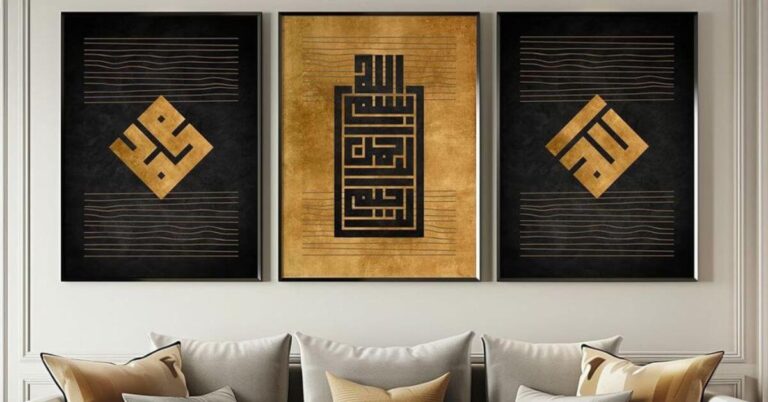
Kufic has appeared in early Qur’anic manuscripts, architectural inscriptions and decorative artwork. Its geometric qualities also make it suitable for contemporary designs, particularly when artists want to combine Arabic lettering with structured patterns.
For modern interiors, geometric Kufic compositions can work well as framed prints or statement wall artwork.
2. Naskh Calligraphy: Clear and Readable Arabic Script
Naskh is a widely recognised Arabic calligraphy style known for its rounded forms, balanced proportions and readability. Its name is associated with copying or transcription, reflecting its historical use in writing manuscripts and books.
Compared with Kufic, Naskh has softer curves and more connected letterforms. Its clear structure makes it suitable for longer written passages and carefully arranged calligraphic compositions.
Key characteristics of Naskh:
- Rounded and flowing letterforms.
- Clear and readable appearance.
- Balanced proportions and consistent alignment.
- Suitable for manuscripts and written compositions.
Naskh became particularly important in the production of manuscripts, including Qur’anic texts. Its influence can also be seen in modern Arabic typography.
For decorative artwork, Naskh can be a suitable choice when the readability of the Arabic text is important. Its balanced appearance can complement both traditional and contemporary interiors.
3. Thuluth Calligraphy: Elegant and Decorative Composition
Thuluth is known for its expressive curves, elongated vertical strokes and decorative letter arrangements. It is one of the most visually prominent Arabic calligraphy styles and has been widely used for architectural inscriptions and ornamental compositions.
The name Thuluth means one-third, referring to a traditional proportion associated with the script’s writing technique.
Unlike simpler writing styles, Thuluth often features complex arrangements in which letters extend, overlap or connect to create a larger composition.
Key characteristics of Thuluth:
- Long vertical strokes.
- Flowing curves and sweeping lines.
- Decorative and expressive lettering.
- Complex compositions with carefully balanced proportions.
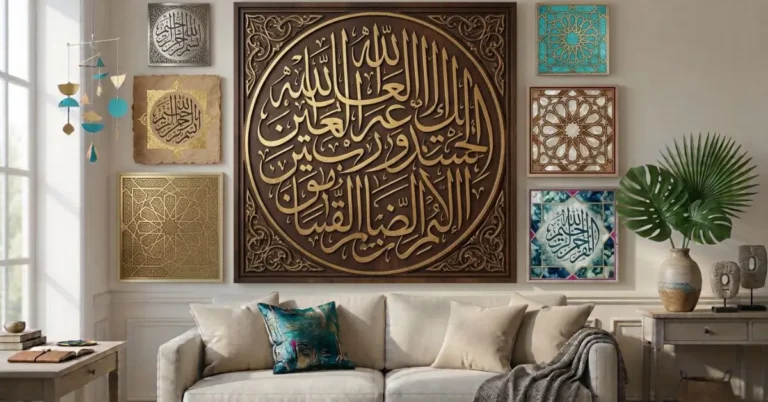
Thuluth can be found in mosque inscriptions, architectural decoration and artistic panels. Its expressive appearance also makes it suitable for large calligraphic wall artwork.
If you want a prominent Arabic calligraphy display, Thuluth can create a strong visual focal point, especially when the artwork has enough space for its extended letterforms.
4. Diwani Calligraphy: Flowing and Intricate Lettering
Diwani developed in the Ottoman period and became associated with official documents and court correspondence. It is recognised for its flowing letterforms, closely connected strokes and decorative arrangements.
Compared with Naskh, Diwani often has a more elaborate appearance. Letters can be arranged closely together, creating compositions with a distinctive sense of movement.
Key characteristics of Diwani:
- Flowing and curved letterforms.
- Closely connected lettering.
- Decorative and intricate compositions.
- Strong visual movement and ornamental detail.
A variation known as Jali Diwani uses more elaborate arrangements and additional decorative elements.
In contemporary artwork, Diwani can be used for expressive calligraphic designs, decorative panels and framed Arabic lettering. Its intricate appearance is particularly suitable for artwork where visual detail is an important part of the composition.
5. Ruq’ah Calligraphy: Simple and Compact Lettering
Ruq’ah is a relatively compact Arabic writing style known for its simplified letterforms and practical appearance. It has been widely used for everyday handwriting because it can be written quickly and efficiently.
Unlike highly decorative scripts, Ruq’ah generally uses shorter strokes and simpler shapes. Its appearance is less elaborate than Thuluth or Diwani.
Key characteristics of Ruq’ah:
- Compact letterforms.
- Short and simplified strokes.
- Practical and relatively straightforward writing.
- Less ornamental than many decorative scripts.
Although Ruq’ah is commonly associated with handwriting, it can also inspire contemporary Arabic lettering and minimalist designs.
Its simple appearance can suit artwork where the focus is on clear lettering rather than elaborate decoration.
6. Nastaliq Calligraphy: Flowing and Diagonal Composition
Nastaliq is a calligraphic style strongly associated with Persian writing traditions and has also been used in parts of South Asia. It is recognised for its sloping arrangement, flowing curves and distinctive descending movement.
Unlike the more upright appearance of Naskh, Nastaliq often creates a diagonal visual flow across the composition.
Key characteristics of Nastaliq:
- Sloping and flowing letter arrangements.
- Elegant curves and descending strokes.
- Distinctive diagonal composition.
- Strong association with Persian and Urdu literary traditions.
Nastaliq is often used for poetry, literary works and decorative compositions. Its flowing appearance can create an elegant visual effect in framed artwork and calligraphic displays.
When selecting Nastaliq artwork, consider the composition and the space required to display its extended lettering.
What Are the Four Types of Calligraphy?
There is no single universal list of exactly four Islamic calligraphy styles. Different educational resources group scripts according to their history, writing techniques or artistic use.
For a simple introduction, four widely recognised styles are:
- Kufic: Known for angular and geometric lettering.
- Naskh: Recognised for clear, rounded and readable writing.
- Thuluth: Known for decorative curves and elongated strokes.
- Diwani: Recognised for flowing and intricate letter arrangements.
These four provide a useful starting point for understanding the differences between structured, readable and highly decorative Arabic calligraphy.
What Are the Six Types of Arabic Calligraphy?
The answer depends on the classification. Six popular styles often introduced in general educational guides are Kufic, Naskh, Thuluth, Diwani, Ruq’ah and Nastaliq.
However, a historical classification of six classical cursive scripts is different. It includes:
- Naskh
- Thuluth
- Muhaqqaq
- Rayhani
- Tawqi’
- Ruq’ah
Kufic is commonly discussed separately in this historical classification. Understanding this distinction helps explain why different sources may provide different lists of Arabic calligraphy styles.
How to Recognise Different Arabic Calligraphy Styles
You can identify many calligraphy styles by observing the shape, direction and arrangement of their letters.
| Calligraphy style | Main visual feature | General appearance |
| Kufic | Angular lines and geometric forms | Structured and bold |
| Naskh | Rounded and balanced letters | Clear and readable |
| Thuluth | Long vertical strokes and curves | Decorative and expressive |
| Diwani | Closely connected lettering | Intricate and flowing |
| Ruq’ah | Compact and simplified letters | Simple and practical |
| Nastaliq | Sloping and descending forms | Elegant and flowing |
These characteristics are useful when comparing examples, although individual compositions can vary depending on the calligrapher, period and regional tradition.
How Islamic Calligraphy Is Used in Modern Artwork
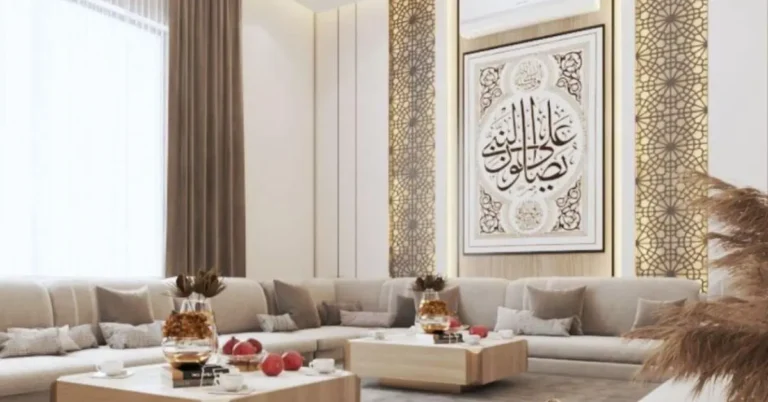
Traditional Arabic scripts continue to influence contemporary art and interior decoration. Artists use calligraphic lettering in framed prints, decorative panels, canvas compositions and modern visual designs.
The choice of script can influence the overall appearance of the artwork. For example, Kufic can introduce geometric structure, while Thuluth can create a more expressive focal point.
If you are exploring Islamic wall art ideas, consider how the lettering style, artwork dimensions and surrounding colours work together.
You can also explore Islamic geometric patterns to understand how structured decorative elements can complement calligraphic compositions.
For more ideas about combining traditional artwork with contemporary spaces, read about Islamic art in modern interior design.
Explore Islamic Calligraphy Artwork at ArtPlus
Understanding different calligraphy styles can make it easier to appreciate the artistic details behind Islamic wall artwork. Whether you prefer geometric Kufic, readable Naskh or decorative Thuluth, each script offers a different visual character.
Explore the ArtPlus Islamic Art Collection to discover artwork inspired by Arabic calligraphy and Islamic artistic traditions.
For displaying selected designs, consider suitable presentation materials such as canvas printing services in Dubai, acrylic printing services, and fine art printing services. The right option depends on the artwork, desired finish and display location.
Conclusion
The different types of Islamic calligraphy demonstrate how Arabic lettering can create a wide range of artistic expressions. From the geometric structure of Kufic and the readability of Naskh to the decorative elegance of Thuluth and Diwani, every style has distinctive characteristics.
Learning about these scripts helps you recognise their historical importance and understand how traditional calligraphy continues to influence contemporary artwork.
Explore the ArtPlus Islamic Art Collection to discover calligraphic designs and artwork inspired by Islamic artistic traditions.
Frequently Asked Questions
What is the oldest type of Islamic calligraphy?
Kufic is one of the earliest major Arabic calligraphy styles and is strongly associated with early Islamic manuscripts and architectural inscriptions. Earlier forms of Arabic writing also existed, so Kufic should not be described as the only earliest form.
Which Arabic calligraphy style is easiest to read?
Naskh is widely recognised for its clarity and readability. It has historically been used for manuscripts and written texts, making it a useful style when the Arabic wording needs to remain clear.
What is the difference between Kufic and Naskh?
Kufic uses angular, structured letterforms with strong straight lines, while Naskh features rounded, flowing and more readable letters. Both have important places in the history of Arabic calligraphy.
Why is Thuluth used in Islamic artwork?
Thuluth is valued for its decorative curves, elongated strokes and expressive compositions. These features make it suitable for architectural inscriptions, ornamental panels and prominent calligraphic artwork.
Are Arabic calligraphy and Islamic calligraphy the same?
The terms overlap but are not identical. Arabic calligraphy refers to the artistic writing of Arabic letters, while Islamic calligraphy is often used more broadly for calligraphic traditions associated with Islamic culture, including artwork using Arabic and other scripts.
Pingback: 9 Beautiful Islamic Wall Art Ideas for Modern Homes
Pingback: How to Choose Arabic Calligraphy Wall Art for Your Home
Pingback: 9 Islamic Wall Art Display Ideas for Living Rooms and Offices