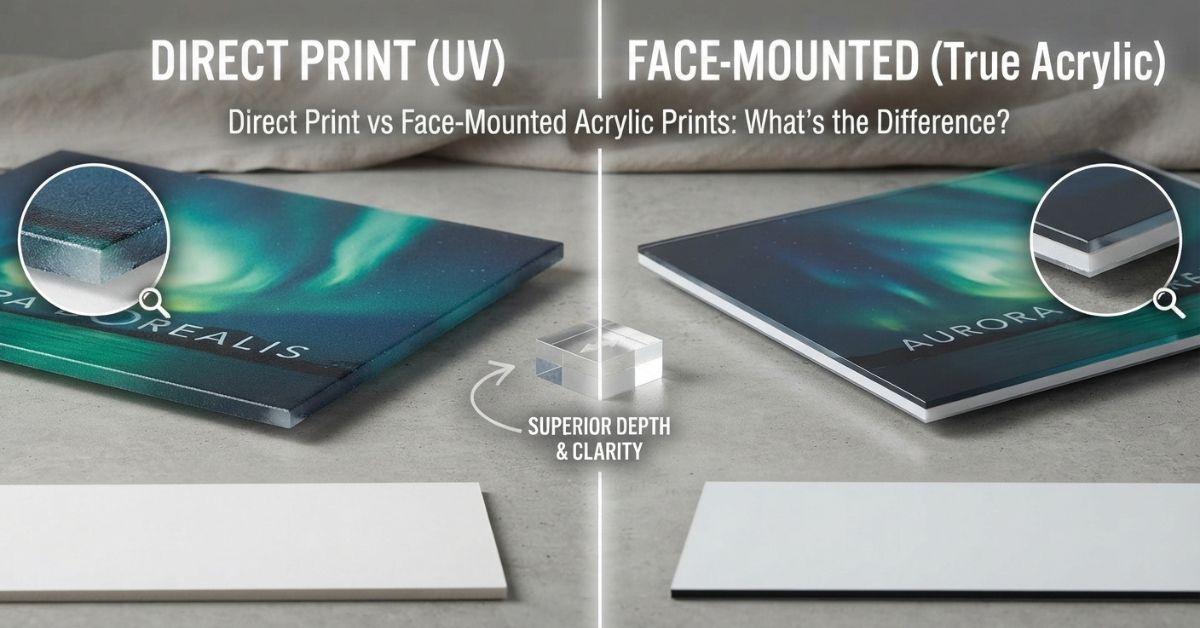
If you’re comparing direct print vs face mounted acrylic, the main difference is where the image is produced. Direct acrylic printing puts the ink directly onto the acrylic sheet, while face-mounted acrylic places a printed image behind a clear acrylic panel.
Both can create a premium, glossy display, but they differ in depth, image appearance, durability, customization, and cost.
Choosing between them is less about which method is “better” and more about how you want the finished artwork to look and where it will be displayed.
Direct Acrylic Printing vs Face-Mounted Acrylic: The Key Difference
The simplest way to understand the two methods is to look at the construction.
With direct acrylic printing, the image is printed directly onto the surface of the acrylic, usually using UV-curable inks. Depending on the design, white ink can also be used to control opacity, highlights, and color density.
With a face-mounted acrylic print, the image is printed separately and then bonded to the back of a clear acrylic sheet. The acrylic becomes a protective front layer, creating visual depth between the surface and the image.
Think of it this way:
Direct printing makes the acrylic part of the printing process. Face mounting makes the acrylic part of the presentation and protection system.
That distinction becomes important when you are choosing artwork for a luxury interior, photography display, office, gallery, or commercial installation.
Direct Print vs Face Mounted Acrylic: Side-by-Side Comparison
| Feature | Direct Acrylic Printing | Face-Mounted Acrylic |
| Image placement | Printed directly onto acrylic | Printed image mounted behind acrylic |
| Surface | Acrylic itself carries the print. | Clear acrylic protects the print |
| Visual effect | Crisp, contemporary appearance | Greater depth and layered appearance |
| Color control | Can use white ink and layered printing | Depends on the underlying print and mounting |
| Customization | Excellent for graphics, logos, and designs | Excellent for photography and fine-art imagery |
| Protection | Ink is bonded to the acrylic surface. | The image is protected behind acrylic. |
| Finish | Clean, modern, glossy options | Deep, glass-like, premium appearance |
| Typical use | Interiors, signage, graphics, wall panels | Photography, fine art, luxury displays |
| Production | Usually more direct and streamlined | More involved mounting process |
The right choice depends heavily on the artwork itself.
A colorful graphic with typography may benefit from direct printing, while a high-resolution photograph may look especially impressive when mounted behind acrylic.
How Direct Acrylic Printing Works
Direct acrylic printing uses a flatbed UV printer to apply ink directly onto the acrylic sheet.
The ink is cured almost immediately using UV light, allowing the image to adhere to the surface without requiring a separate photographic print.
For some designs, white ink is printed as an additional layer. This is particularly useful when the artwork needs stronger colors or when areas of transparency are part of the design.
Why choose direct printing?
Direct printing is particularly useful when you need:
- Custom graphics or artwork
- Corporate branding
- Logos and typography
- Large acrylic wall panels
- Decorative interior panels
- Images with transparent or semi-transparent elements
- Custom shapes or specialty acrylic applications
It can also be practical for projects where the acrylic itself is part of the visual design rather than simply a protective layer.
For example, a designer creating a modern office reception area might use directly printed acrylic panels containing a subtle geometric pattern or company branding. The acrylic becomes both the material and the artwork.
ArtPlus offers direct UV printing on acrylic for residential, commercial, and creative applications, including custom wall art and large-format projects.
How Face-Mounted Acrylic Prints Work
Face-mounted acrylic prints use a different approach.
The image is first produced on a separate photographic or fine-art medium. It is then carefully bonded to the reverse side of a clear acrylic sheet.
When viewed from the front, the transparent acrylic sits between the viewer and the image. This creates a clean, dimensional appearance while helping protect the printed image.
The result is often associated with museum-grade acrylic display because of its depth, clarity, and polished presentation.
Why choose face mounting?
Face-mounted acrylic prints are a strong option for:
- Professional photography
- Fine-art photography
- Gallery artwork
- High-end residential interiors
- Hotel and hospitality interiors
- Collector-quality displays
- Images where depth and tonal detail are priorities
The acrylic acts almost like a lens over the image. Light interacts with the clear surface before reaching the print, which can make colors and contrast appear particularly rich.
Which Method Gives Better Image Quality?
There isn’t one universal winner.
Image quality depends on several factors, including the source file, printing technology, acrylic quality, ink or photographic process, mounting technique, viewing distance, and finishing.
For detailed photography, a well-produced face-mounted print can provide an impressive sense of depth because the image sits behind a substantial clear surface.
Direct printing, however, offers greater control when the artwork contains graphic elements, typography, branding, or intentional transparency.
A premium acrylic print is only as good as the image preparation, material, printing process, and finishing behind it.
This is why comparing only the printing method can be misleading. The complete production process matters just as much.
Acrylic Mounting Comparison: Which Looks More Premium?
If your priority is a luxury acrylic finish, face mounting generally creates the more layered and dimensional appearance.
The clear acrylic front gives the artwork a sense of depth that can make a photograph appear almost suspended beneath the surface.
Direct printing has a different aesthetic. It tends to look cleaner, sharper, and more contemporary, particularly when used for graphic artwork or large interior panels.
Neither method automatically produces a higher-end result. The quality of the acrylic, print resolution, color management, mounting adhesive, edge finishing, and installation can all influence the final appearance.
A practical example
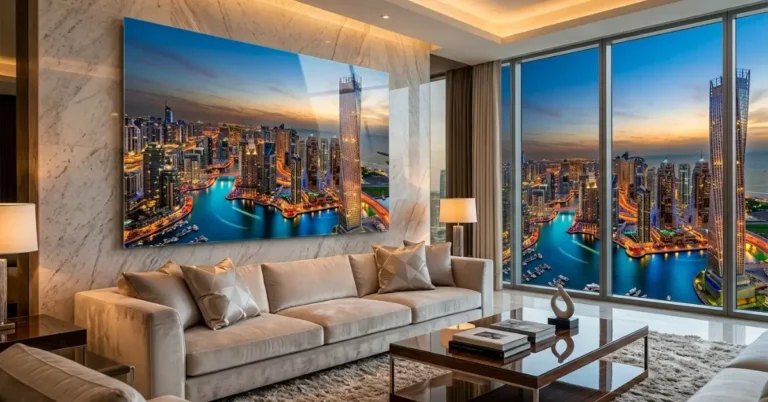
Imagine two large prints of the same Dubai skyline photograph.
A directly printed version may have a crisp, modern appearance that works well in a contemporary office.
A face-mounted version may give the same photograph greater visual depth and a more gallery-oriented appearance, making it better suited to a luxury residence or curated hospitality space.
The artwork hasn’t changed. The production method has.
Direct Printing or Face Mounting: Which Should You Choose?
Use direct acrylic printing when the project involves graphics, branding, custom designs, or artwork where the acrylic itself should be part of the final visual effect.
Choose face-mounted acrylic when the priority is photographic detail, depth, protection, and a refined gallery-style presentation.
A useful decision rule is
Choose the printing method based on the artwork first, then choose the acrylic finish and mounting system around the viewing environment.
Consider these five questions before ordering:
- What type of artwork are you printing?
Photography and fine art may benefit from face mounting, while graphics and branding often work well with direct printing. - How will the artwork be viewed?
Close-up viewing makes surface quality, depth, and fine detail more noticeable. - Where will it be installed?
A home, gallery, office, hotel, or retail environment may have different visual and practical requirements. - Do you need transparency or white areas?
Direct UV printing can provide useful control through white-ink layers. - What kind of finish are you trying to achieve?
For a minimalist contemporary look, direct printing can be excellent. For a layered, glass-like presentation, face mounting may be the better fit.
What About Back Mounted Acrylic?
The term back mounted acrylic is often used interchangeably with face-mounted acrylic, although terminology can vary between print studios.
In this construction, the image is positioned behind the transparent acrylic rather than printed on its front surface.
That creates two important advantages: the acrylic protects the image from direct contact, and the transparent layer contributes to the visual depth of the finished artwork.
The quality of the bonding process matters here. Poor mounting can introduce bubbles, uneven areas, or visual distortions that undermine an otherwise high-quality print.
Is Face-Mounted Acrylic Worth the Extra Cost?
For the right project, yes.
Face mounting involves additional production steps compared with printing directly onto an acrylic sheet. You’re paying for the separate print, mounting process, materials, and finishing.
That additional cost makes more sense when the artwork is intended to be a centerpiece rather than a simple decorative panel.
For example, a photographer selling limited-edition work may prioritize depth, presentation, and long-term display quality. A business producing dozens of branded acrylic panels may prioritize consistency, customization, and efficient production.
The best acrylic mounting method is the one that supports the purpose of the artwork—not simply the one with the highest price.
How ArtPlus Approaches Acrylic Printing
ArtPlus provides custom acrylic printing in Dubai using UV printing technology and works with both residential and commercial projects. Its acrylic services include custom artwork, photography, wall displays, and large-format applications.
For projects where the distinction between direct printing and mounting matters, discussing the artwork, size, viewing distance, lighting, and installation environment before production can help prevent an expensive mismatch between the desired appearance and the finished piece.
ArtPlus also provides other printing options, including canvas, metal, glass, wood, wallpaper, and framing, which can be useful when acrylic is being compared with alternative display materials.
Final Takeaway
The choice between direct printing and face mounting comes down to the intended visual effect and the type of artwork.
Direct acrylic printing is versatile, modern, and well suited to graphics, branding, and custom designs. Face-mounted acrylic creates a more layered presentation and is particularly compelling for photography and fine-art displays.
If you’re choosing between the two, don’t start with price alone. Start with the artwork, viewing environment, desired finish, and expected lifespan of the display.
Frequently Asked Questions
Can you print directly on acrylic?
Yes. UV printers can apply ink directly onto acrylic sheets and cure it using ultraviolet light. White ink can also be used to improve opacity and color control for certain designs.
What is the difference between a canvas print and a mounted print?
A canvas print reproduces an image on canvas, which has a textured, softer appearance. A mounted acrylic print uses acrylic as part of the final display and typically creates a sharper, glossier, more contemporary presentation.
What are the three types of acrylic?
For display and printing, acrylic can broadly be supplied as clear, translucent/frosted, or opaque/colored material. From a manufacturing perspective, cast and extruded acrylic are two major production types, so the exact “three types” depends on the classification being used.
What are the four types of printing?
Traditional printmaking is commonly divided into relief, intaglio, planographic, and stencil processes. Modern commercial printing uses different categories, including digital, offset, screen, and large-format printing.
Is direct acrylic printing better than face mounting?
Neither is automatically better. Direct printing is often more suitable for graphics, branding, and custom designs, while face mounting is particularly attractive for photography and premium artwork where depth and presentation matter.
Which acrylic printing method is best for photography?
For high-end photographic displays, face-mounted acrylic can be an excellent choice because the clear acrylic layer adds depth and protects the image. Direct UV printing can still be a strong option when customization or specific graphic effects are more important.